Sheet TG-07-Q / INDEX
Question Rooms on the Tor Guide Desk
Rooms, not a synonym dump.
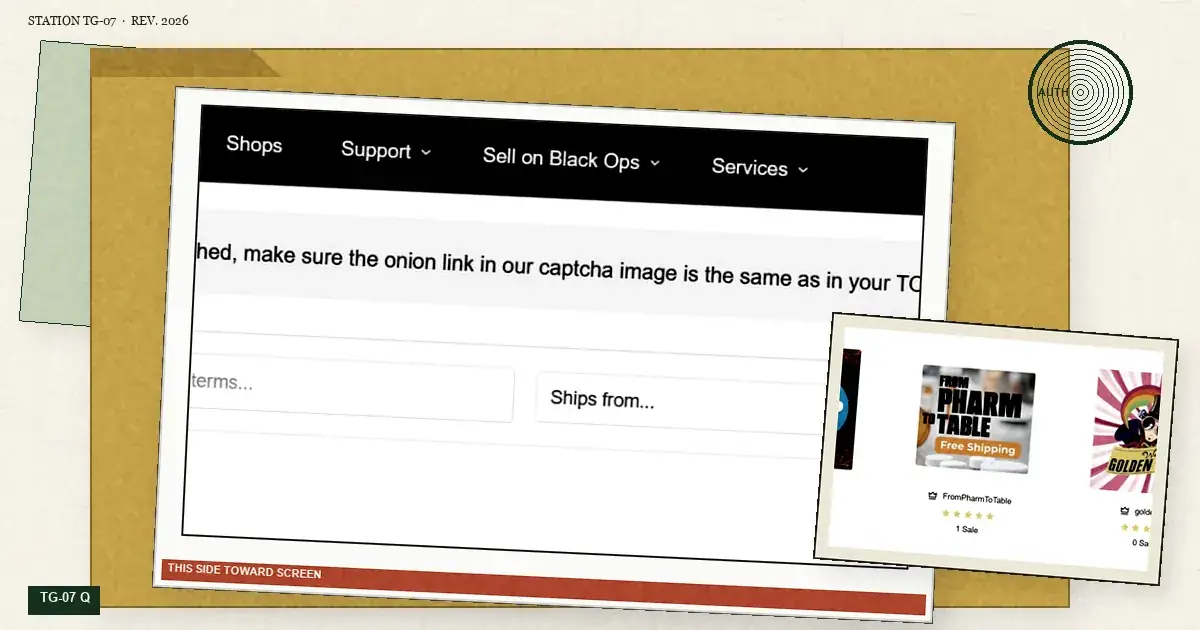
The question sleeve on this tor guide separates three problems that are often answered badly when compressed into one enormous FAQ. Sighting asks what a clearnet researcher can honestly observe. Voucher asks how a fifty-six-character v3 citation should be evaluated. Habitat asks why onion names behave differently from conventional web names. Each requires different evidence and different limits.
Splitting the rooms is not merely an indexing choice. It prevents an answer about browser behaviour from being mistaken for authentication, and prevents an address-format check from being mistaken for a live-status report.
Choose the question that brought you here. None of the rooms contains registration, purchasing, funding, or vendor instructions.
I. How this tor field guide splits a FAQ sleeve
The sighting room is appropriate when a reader wants to know what inclusion in the archive means. It explains the difference between public HTML, an operator-provided capture, a circulating identifier, and an independently signed statement. It also states why none of those observations grants access to escrow logs, inventory, disputes, or operator intent.
The voucher room addresses identity at the string level. Modern v3 names encode an Ed25519 public key and contain fifty-six characters, including checksum and version information, but validity of form is not attribution to a brand. The room focuses on complete comparison, prior trust references, PGP signatures, lookalikes, and the limits of copy controls.
The habitat room handles protocol classification. Conventional DNS does not resolve .onion names, so an ordinary-browser failure should not trigger a helper download or an unsupported seizure theory. That room discusses Tor Browser provenance at a high level while deliberately avoiding a destination-opening widget or a market access sequence.
II. Onion itinerary through questions, not pastes
An onion itinerary through the questions begins with the uncertainty, not with the most dramatic heading. If the issue is whether a screenshot proves control of a key, open sighting. If two long strings differ, open voucher. If a mainstream browser reports that the name cannot be found, open habitat. Precise classification keeps answers short enough to use and hard enough to misapply.
The child pages share an evidentiary hierarchy without repeating the same essay. Upstream software signatures address client provenance, while a prior PGP key can attribute a statement. An Ed25519-derived onion name identifies a service key, but search position, copied branding, interface polish, and uptime claims occupy lower and different levels because they do not bind those identities together.
A giant FAQ would make internal search convenient at the cost of context. Short extracted answers are especially vulnerable to appearing in snippets without their caveats. Separate pages allow the relevant warning, date, examples, and nearby links to travel with each answer rather than leaving a one-sentence rule to carry more certainty than it deserves.
III. Station notes on signatures and extra tabs
Station notes treat unanswered questions as legitimate outcomes. The archive may be unable to determine whether two captures came from the same operator, whether a cited mirror remains controlled by the original key holder, or whether a rumour describes a real event. Naming the missing evidence is more useful than filling the space with confident speculation.
The tor guide question index also declines support theatre. There is no mailroom that contacts market operators, no chat agent, and no mechanism for recovering accounts or funds. A page claiming those capabilities while copying this layout is contradicting the colophon and should not inherit trust from the familiar design.
For personal research notes, record the question, observation date, source type, and confidence separately. That small structure exposes when an answer came only from repeated articles or a visual impression. It also makes later corrections possible without rewriting an uncertain sighting as though it had always been settled fact.
IV. Index questions for the FAQ sleeve
Which room should a new reader open first?
Open voucher before copying a string, habitat after a conventional-browser resolution error, and sighting when assessing what this archive claims to observe. The uncertainty determines the room.
Why not one giant FAQ?
The three topics rely on different technical facts and evidence. Separate pages preserve context, reduce accidental overgeneralisation, and avoid an index that simply repeats every child answer for search traffic.
Will these answers authenticate a plot?
No; they explain methods and limitations rather than authenticating a plot. Authentication would require independent cryptographic evidence, such as a statement signed by a previously trusted key, not an FAQ hosted beside the citation.
Close of sheet
A useful answer should narrow uncertainty without pretending to eliminate evidence the reader never had. Leave the other rooms unopened unless another distinct question remains.
The tor guide keeps this index compact so sighting, voucher, and habitat retain their own arguments. Three clearly labelled files are better than one page whose answers quietly exchange meanings. Return only when the question itself has changed.