Sheet TG-07-Q3 / HABITAT
Habitat Questions on the Tor Guide Desk
Ecology. Not a boarding gate.
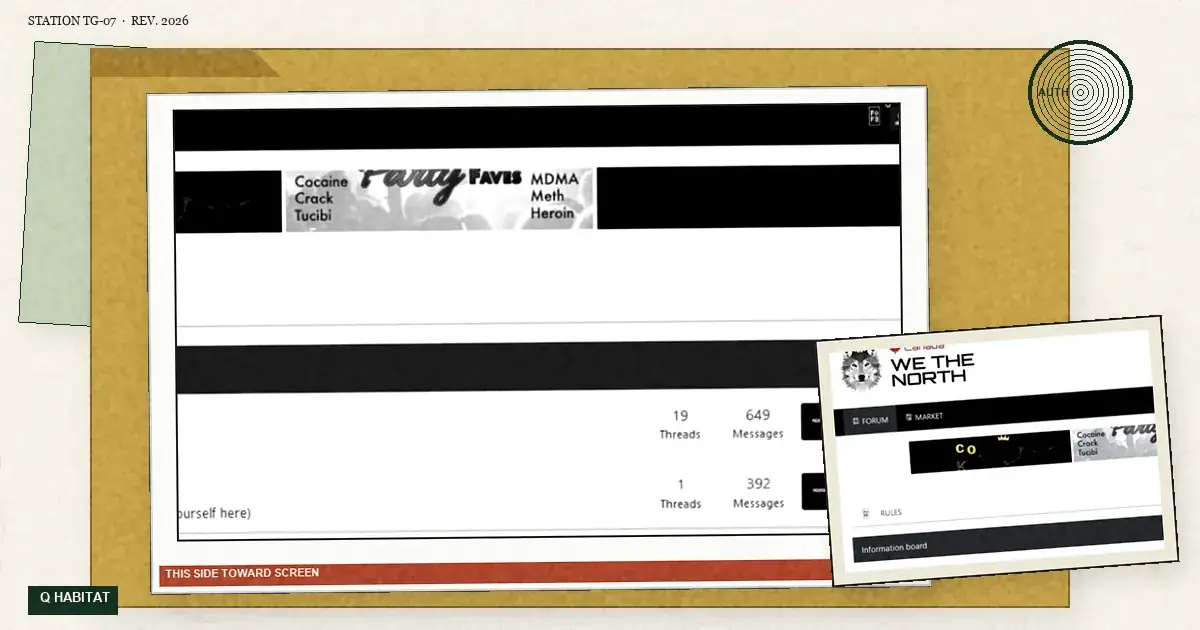
The habitat room of this tor guide answers a classification problem: .onion names do not use ordinary DNS and therefore do not behave like conventional web domains in mainstream browsers. A failure in the wrong client is expected. It does not prove that the service vanished, and it should not drive a reader toward an unsolicited helper application.
Tor Browser is the relevant general-purpose client, but its provenance matters more than a screenshot of settings. The defensible source is the Tor Project with the signatures and release information that project publishes.
This FAQ explains the edge without embedding a connect control, a destination, or any commercial sequence.
No connect widget. A clone that adds one is not Station TG-07.
I. How this tor field guide describes a habitat edge
V3 onion services use self-authenticating names tied to Ed25519 keys and establish connections through Tor's protocol rather than public DNS resolution. The fifty-six-character name is consequently both identifier and cryptographic material. A conventional resolver has no record to return, so its error message describes the mismatch between system and name rather than the condition of the onion service.
A clearnet archive occupies another layer. Its HTTPS certificate and canonical domain can authenticate the archive to a browser, but cannot authenticate an onion identifier printed in an article. Readers should resist the intuitive but false bridge between a trustworthy clearnet padlock and a separate hidden-service key.
The distinction also explains why an ordinary search result cannot serve as an onion authority. Search systems index clearnet documents that mention strings; they do not establish control of the corresponding Ed25519 private keys or verify the market identities claimed by those documents.
II. Onion itinerary that allows stopping at the pass
An onion itinerary at the habitat edge starts with software supply-chain evidence. Obtain Tor Browser from upstream, assess its published signature material, and reject market-specific installers, extensions, VPN bundles, and remote configuration tools. A destination that insists upon extra software is asking to control the observer before the observation begins.
After client provenance comes voucher attribution. Compare every character of the v3 name against a PGP-signed source associated with a previously established fingerprint. If that reference does not exist, the technically correct client does not cure the identity gap. It can connect to an attacker's valid onion service just as successfully as to any other.
Stopping is the appropriate response when the chain is incomplete. Repeatedly trying alternate mirrors from search snippets increases exposure without creating evidence. A research note can record the error class and missing reference, then defer the question until an attributable document appears.
III. Station notes on errors, splashes, and widgets
Station notes distinguish local, network, service, and documentary questions. A conventional-browser error is local classification. A Tor timeout may have several network or service causes. A law-enforcement notice is a document whose authenticity must be assessed. An archive 404 concerns this clearnet site's routing. Treating all four as proof of one event produces confident misinformation.
The tor guide habitat room declines connection widgets because their target can be changed without altering the surrounding prose. Such controls also encourage readers to let the current page choose the identifier, defeating the independent comparison this archive recommends. Plain explanation is safer and easier to audit.
Legal scope should remain explicit. Tor supports journalism, research, privacy, and many other lawful uses, while market activity may raise serious criminal and civil issues. This card is not legal advice and does not interpret local law. A protocol explanation cannot determine whether particular conduct is permitted, and technical privacy should never be confused with legal immunity. The sheet addresses naming boundaries and deceptive software prompts only.
IV. Habitat questions without a connect control
Why did an ordinary browser fail on an onion name?
The name is resolved within Tor rather than ordinary DNS. That expected mismatch does not, on its own, reveal whether an onion service is available or who operates it.
Should a reader install a helper to 'see the real onion'?
No. Unsolicited helpers and market-branded browser packages add an untrusted software supplier. Use upstream Tor Project releases and current published verification guidance.
Does this room teach how to reach a market?
No. It explains the naming boundary, client provenance, and identity gap. It includes no connect widget, purchasing sequence, account steps, or destination recommendation.
Close of sheet
Correctly naming the failure prevents a predictable error from becoming leverage for a malicious download. Client, resolver, service, and identity are related, but they are not interchangeable.
Keep the habitat card beside the tor guide border notes. If software provenance or voucher attribution remains uncertain, record that uncertainty and leave the destination unopened. That record is a valid research result, not an unfinished journey.