Sheet TG-07-Z / COLOPHON
Colophon for Station TG-07
Independent paper. Not an operator channel.
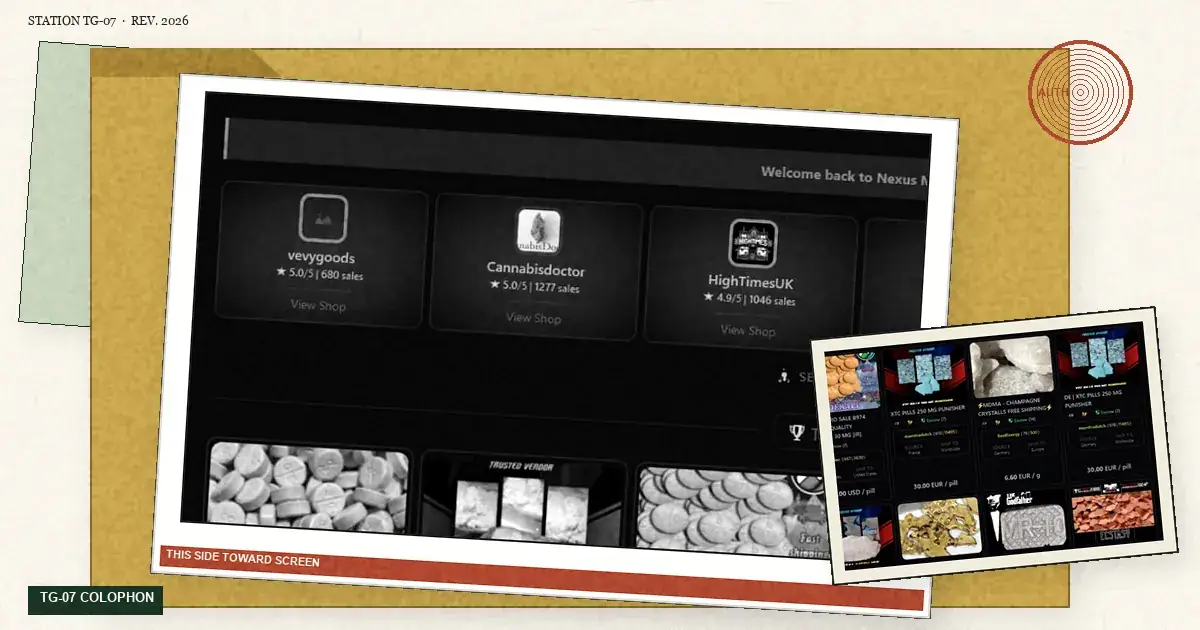
This colophon identifies the tor guide as an independent static publication typeset on 8 September 2026. It is not operated by, affiliated with, or authorised to speak for any hidden service. The cream folders, slide mounts, file codes, and stamp marks are a visual system for organising research; none represents a cryptographic signature, official seal, or channel to an operator.
Pages are generated as static HTML with local CSS. Interface photographs are composites based on operator-provided captures and are labelled as exhibits rather than live views. The distinction preserves their documentary value without claiming independent access.
If this archive conflicts with a verifiable PGP-signed statement from a previously trusted key, the signed text deserves priority within the scope of what it actually says.
I. How this tor field guide is typeset and what it refuses
Editorial independence determines what the site omits. There are no registration forms, wallets, vendor onboarding pages, purchasing instructions, or support chats. Those elements would make the publication participate in the activity it is attempting to document. Harm-reduction information remains because ignoring physical risk would be irresponsible, but it is not attached to listings or framed as product advice.
The publication also separates evidence from ornament. A red authentication stamp in the design is merely CSS or an image asset; the word authentic inside a drawing has no relationship to PGP verification. Likewise, a 35mm-style mount identifies a screenshot as a still. It cannot bind the image to an Ed25519 key or certify that the pictured service was reachable.
Static generation creates inspectable pages and avoids third-party styling frameworks or remote interface components that could alter presentation unexpectedly. It does not make the prose infallible. Dates, source labels, and explicit corrections are still necessary because static mistakes can persist and rank just as readily as dynamic ones.
II. Onion itinerary versus typefaces and plates
The onion itinerary does not require a visit to the colophon, but research readers may use it to assess incentives and method. The archive's income, hosting, authorship, and source relationships are distinct questions from whether an onion voucher is correctly attributed. A polished disclosure cannot replace string verification, just as a correct string cannot validate every editorial claim.
Typography reinforces hierarchy without impersonating a market. Book serif titles, condensed labels, typewriter file codes, and occasional cursive captions evoke a field archive on cream stationery. The design avoids storefront grids and transaction controls. Readers should still judge purpose from behaviour and content because an impersonator can reproduce every font and border.
Cross-domain links follow editorial assignment rather than automatic reciprocity. A footer filled with nominally related sites can create a false network of corroboration when those sites share copied sources. Subject-specific links may be added where they genuinely extend a record, but absence of a link should not be interpreted as hostility or evidence about another publication.
III. Station notes on affiliation, chrome, and canonical
Station notes define the limits of contact. The archive has no mechanism to relay messages to markets, recover accounts, adjudicate disputes, or confirm support identities. Any page using this name and appearance to offer such services conflicts directly with the publication's stated role and should be treated as a lookalike rather than a convenient extension.
The tor guide colophon also distinguishes canonical URLs from authority claims. A canonical tag tells search engines which clearnet URL represents this edition of a page. It says nothing about hidden-service ownership. Similarly, an IndexNow key concerns search indexing and cannot verify a cited onion identifier.
Corrections should preserve the old observation date, explain the changed text, and identify the basis for revision. Silent replacement is tempting when an address or claim proves wrong, but it deprives later readers of evidence about how misinformation propagated. An archive earns trust by making its uncertainty and correction history legible.
IV. Colophon questions about the printer's note
Is Tor Guide affiliated with any hidden service?
No. It is an independent informational publication and has no operator role, marketplace function, or privileged access to hidden-service systems. Claims of affiliation on copied pages contradict this colophon.
May someone reuse the cream-desk layout?
The visual treatment can be copied, which is precisely why it should never authenticate content. Readers should compare canonical clearnet URLs, editorial behaviour, and cryptographic sources rather than trusting stationery.
Where are the sources?
The sources card explains evidence categories, provenance labels, public-health context, and exclusions. It is a methodology note rather than a vendor bibliography or operator keyring.
Close of sheet
The printer's claim is intentionally modest: independent, dated, static research with visible limits. Everything stronger requires evidence supplied by the subject and assessed on its own terms.
Use this tor guide colophon to identify what the publication controls—its clearnet pages and editorial choices—and what it does not control: onion keys, market systems, or operator communications. That boundary is the publication's most important disclosure.