Sheet TG-07-D / PLOTS
District Cards on the Tor Guide Desk
Seven habitats. No vendor table.
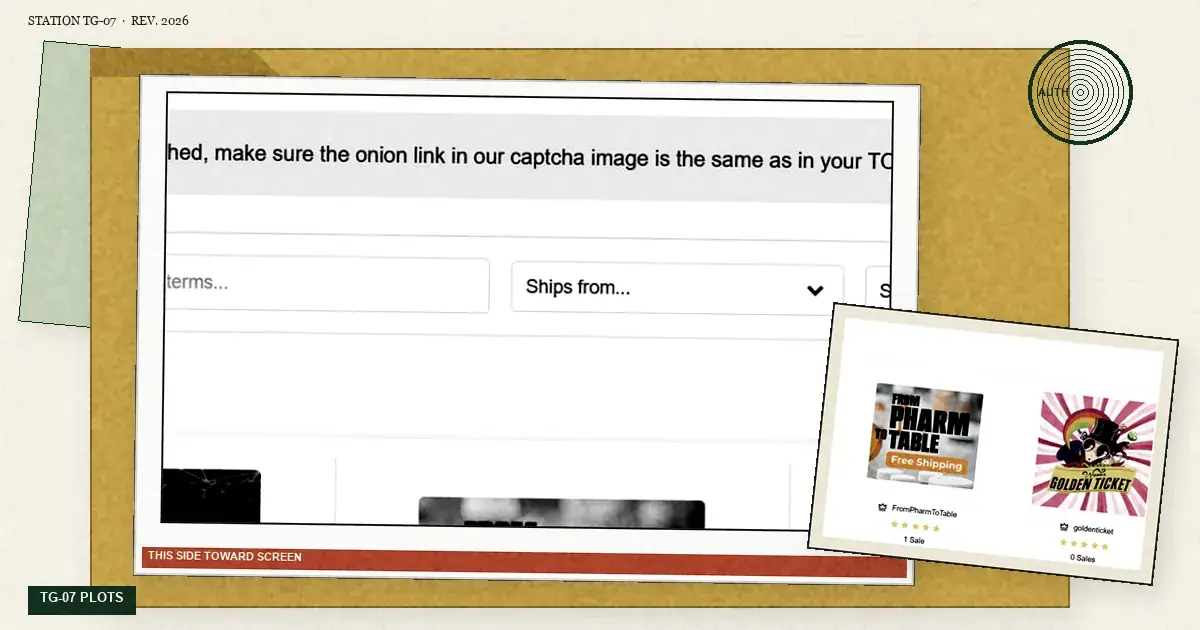
The plots file on this tor guide is an index of names observed in public discussion, not a ranking of places to visit. Nexus, Torzon, Drughub, BlackOps, Dark Matter, Mars, and We The North receive separate habitat cards because each name has its own documentary trail, vocabulary, and imitation risk. The overlapping-paper design keeps that distinction visible without pretending the cards are equal products.
Every plot sheet is dated 8 September 2026 and carries three circulating v3 identifiers. Those fifty-six-character names are citations, not endorsements: their format encodes an Ed25519 public key, yet correct length alone says nothing about who controls it. A prior PGP-signed statement remains stronger evidence than this index, a search result, or a familiar-looking header.
Use the list to choose one research subject. Opening all seven at once makes visual comparison harder and encourages the prefix-only reading on which lookalikes depend.
I. How this tor field guide stacks habitat cards
A district belongs here because the market name appeared repeatedly enough in 2026 reporting to justify a dedicated record. Inclusion does not mean that the hidden service was reachable when the page was typeset, that listings were inspected, or that any operator claim was verified. The index records the scope of the archive and gives each subject a stable internal path; it does not award a badge.
Common names are especially poor authenticators. A copied wordmark, colour palette, or announcement headline can be reproduced without possession of the Ed25519 private key behind a genuine v3 address. Even a photographic interface capture proves only that particular HTML was visible when the image was made. It cannot establish continuity between the photographed page and an onion string pasted beside it.
That is why the linked names, rather than onion strings, are the only content in the plot index itself. Voucher material stays on individual sheets where dates, caveats, and the relevant visual exhibit can be read together. Separating navigation from identifiers also prevents this page from becoming the sort of undated link dump that remains indexed long after its sources have changed.
II. Onion itinerary through the districts file
The safest onion itinerary through this district file is deliberately narrow: read the index note, select the subject that prompted the visit, and examine its citations against a source you trusted before arriving. A page encountered through an advertisement cannot bootstrap its own authority by declaring itself official. Search engines measure relevance and popularity signals; neither property authenticates a hidden-service key.
The seven records are not arranged by supposed quality, longevity, inventory, or customer sentiment. Those categories would require evidence this station does not possess, and star ratings copied from an interface are operator or user claims rather than measurements. Alphabetical or visual prominence should likewise not be mistaken for advice. The cards are simply an editorial table of contents made legible on a small screen.
If fatigue has already reduced a fifty-six-character comparison to the first few symbols, return to the packing and voucher notes instead of choosing another plot. Homoglyphs are not the only problem; ordinary substitutions in the long middle of a string are easy to overlook when several near-identical tabs are open. One careful comparison produces more information than seven casual impressions.
III. Station notes on missing cards and fatigue
Station notes distinguish three absences that affiliate pages often collapse into drama. A missing URL on this clearnet archive may be an editorial or deployment error. An onion service that fails to answer may be experiencing temporary reachability trouble. A signed retirement announcement is a document attributable to a key. Only the last supports a specific historical claim, and none can be inferred from the other two.
The tor guide district record also avoids automatic links to unrelated research domains. Such links can create an appearance of mutual verification even when the sites merely copy one another. Internal plot pages therefore remain the complete route from this index unless an explicit editorial assignment later identifies a relevant peer and a matching subject page.
Treat the cream cards as finding aids. Their value lies in making seven distinct dossiers easier to locate while keeping dates and evidentiary limits attached. Should a copied version add price tables, registration prompts, or a connect control, those additions change the purpose of the page and provide a practical reason to leave it.
IV. District questions for the index sleeve
Why are the plot cards uneven?
The arrangement signals an editorial stack rather than a uniform product grid. It has no evidentiary meaning: all seven links remain ordinary entries in the same index, and visual position is neither a ranking nor an endorsement.
Does the index claim all plots are reachable today?
No. It records subjects discussed in 2026 and dates their sheets. Reachability changes too quickly for a static clearnet page to present as telemetry, and the station does not operate a live-status probe.
May a reader open every plot in one sitting?
Nothing prevents it, but the archive recommends one subject at a time. Long v3 names punish hurried comparison, especially when similar branding and multiple tabs compete for attention.
Close of sheet
This index has done its job once it has led to one bounded piece of research and made the limits of that record clear. It is not a checklist, a scorecard, or a substitute for a signed source.
Return to the tor guide front desk when the seven names begin to blur together. The date on each card matters; the apparent tidiness of the stack does not.