Sheet TG-07-H / LEDGER
Ledger Sleeve on the Tor Guide Desk
Words on paper. No addresses to pay.
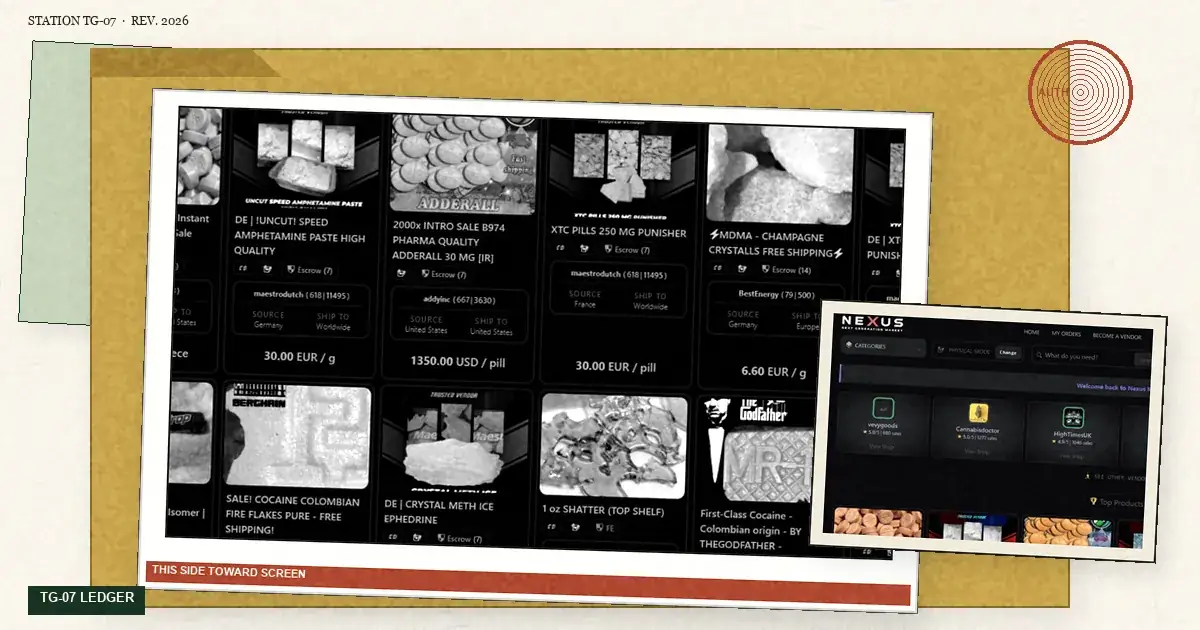
The ledger on this tor guide exists to interpret language found in market reporting, not to facilitate payment. Monero and bitcoin appear in screenshots, operator claims, journalism, and affiliate articles, often with assumptions left unstated. Recording those terms helps readers understand the documents without turning this archive into a cashier or a tutorial.
Settlement claims deserve skepticism because they are frequently used as proxies for privacy, competence, or trustworthiness. A rail cannot authenticate a fifty-six-character onion name, prove that escrow exists, or reveal who controls a displayed destination. Those are separate evidentiary questions.
The two child cards divide historical BTC references from contemporary XMR rhetoric. Neither contains rates, wallet setup, addresses, or transaction steps.
I. Why this tor field guide files settlement words
A research index needs settlement vocabulary because omissions can distort the source record. If a supplied interface capture labels a rail, the label is part of the exhibit and may help date or compare versions of the interface. It should be transcribed as an observed claim, with no implication that the station tested payment processing or confirmed where funds would go.
Escrow language requires the same discipline. Descriptions such as multisignature, automated release, or protected payment explain what an operator says the system does; they are not audits. Verifying such claims would require access to code, key arrangements, dispute records, and operational controls that a public clearnet archive does not have. Repeating the marketing adjective safe would conceal that gap.
The boundary is straightforward: explain terms needed to read public material, but omit procedures that move value. This permits historical and rhetorical analysis while avoiding deposit guidance, mixer instructions, fee optimisation, wallet recovery, or destination selection. It also gives copied versions a clear test—an added payment address contradicts the page's stated function.
II. Onion itinerary that does not start at a till
The onion itinerary should not begin at the ledger because payment vocabulary answers none of the prior identity questions. Software provenance comes first, followed by full-string comparison against an independently obtained PGP-signed voucher. Only after those checks does it make sense to interpret what a captured interface claimed about settlement, and even then the claim remains unaudited.
Rail choice is also a poor shortcut for judging a service. Privacy properties differ across technologies and usage patterns, yet those differences cannot cure phishing, malicious client software, copied keys, false listings, or operator misconduct. Treating one coin label as a trust badge transfers a technical debate into a context where it proves almost nothing.
Readers seeking financial, tax, or legal advice should use qualified sources in their jurisdiction. Market gossip is unreliable guidance for all three. The Monero and bitcoin child sheets remain narrowly documentary, showing why each word appears in the archive and what conclusions the word cannot support.
III. Station notes on mixers, slogans, and clones
Station notes reject QR codes and machine-readable destinations because they conceal characters from ordinary inspection and invite accidental action. The archive has no reason to receive money, collect wallet identifiers, or ask visitors to test an address. A clone that introduces those elements should be treated as a different and potentially hostile site regardless of how closely it copies the stationery.
A tor guide ledger must also resist laundering promotional claims through neutral-sounding prose. When an interface says funds are protected, the accurate record is that the interface displayed that sentence on a given date. The archive cannot upgrade the sentence into a finding about custody merely by placing it beneath an academic-looking heading.
Public-health context stays adjacent where market reporting discusses drugs, but it is not linked to payment mechanics. Drug checking, naloxone availability, potency uncertainty, and the risk of using alone concern physical safety independent of any rail. Keeping these domains separate prevents a financial label from being mistaken for a safety assessment.
IV. Ledger questions that should stay dull
Why mention Monero at all?
Because the term appears widely in 2026 market reporting and interface captures. Explaining its presence preserves context; it does not instruct a reader to obtain, store, or transfer it.
Does this host process any payment?
No. There is no cart, checkout, receiving address, wallet connection, or payment support. Any page copying this design while requesting value is performing a different function.
Is escrow described as safe here?
No. Escrow is recorded as an operator or affiliate claim unless independent audit evidence exists. The station cannot inspect custody keys, internal balances, or dispute handling.
Close of sheet
Use the ledger to read source material more precisely, then put it aside. A vocabulary note becomes misleading the moment it nudges a reader from interpretation toward a transaction.
On this tor guide, settlement remains behind identity and provenance in the filing order. Knowing a rail's name does not identify a service, validate an address, or make an operator promise true.