Sheet TG-07-Y / SOURCES
Sources Card on the Tor Guide Desk
Kinds of evidence. Not a vendor list.
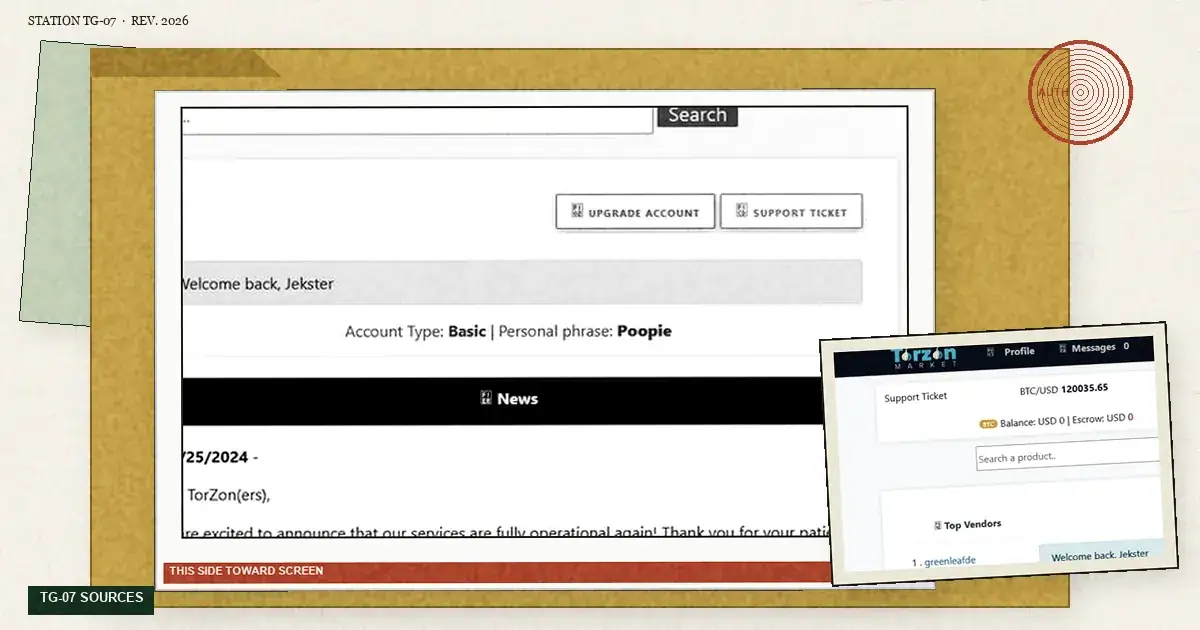
The sources card for this tor guide describes an evidence hierarchy rather than listing marketplaces. Public HTML, dated captures, circulating v3 names, signed statements, technical documentation, and public-health guidance answer different questions. Placing them in one bibliography without source labels would imply equivalence where none exists.
A screenshot can document appearance; a Tor Project specification can explain fifty-six-character v3 names and Ed25519 identity; a verifiable PGP statement can attribute text to a key. Each remains limited to its own claim.
The archive excludes price tables, vendor directories, private support records, and anonymous allegations offered as settled fact. More material does not automatically produce a better source base.
I. What this tor field guide will treat as citable
Primary evidence is defined relative to the question. For interface history, an original capture with known provenance may be primary visual material. For an operator's announcement, the signed message is primary evidence of what that key asserted. For whether the assertion is true about internal operations, the same message is still only a claim and may need records the archive cannot access.
Onion strings on plot cards are transcribed as dated citations. Their v3 format can be assessed, but association with a market name depends upon attributable publication. When the source is operator-provided, that fact is disclosed; when the string merely circulates through public articles, the weaker provenance remains visible rather than being improved by repetition.
Secondary reporting can add chronology, independent observation, and context if it names sources and distinguishes confirmation from quotation. Affiliate pages that reproduce identical wording and identifiers without attribution are not independent corroboration. They may still be useful evidence of how a claim spread through search results, which is a different research question.
II. Onion itinerary for readers who ask says-who
An onion itinerary for source review begins with the statement being supported. Protocol facts should point to the Tor Project or relevant technical specifications. Identity claims should point to signed material and disclose fingerprint history. Interface descriptions should identify image provenance and date. Public-health recommendations should rely on established health agencies and harm-reduction organisations rather than market copy.
Search engines are discovery tools, not sources of authenticity. A result's rank can lead to a document, but the rank itself does not verify its claims or its key. Cached snippets may truncate caveats, combine stale text with a new title, or remain visible after the underlying page changes. Researchers should cite the document they inspected and record the inspection date.
The source sheet also resists bibliography inflation. Listing every site that repeats a market name can reward low-quality publishers and create an appearance of consensus. A smaller set of clearly characterised evidence is more useful, particularly when disagreements, missing signatures, and uncertain dates are stated directly.
III. Station notes on internals the desk cannot know
Station notes exclude private tickets, doxxing material, leaked account records, and unsolicited transaction screenshots. Beyond ethical and legal concerns, such objects are difficult to authenticate and often expose people who did not consent to publication. The archive's purpose can be served through public claims, supplied promotional exhibits, and method notes without becoming a repository for personal data.
The tor guide sources card is complete only when it also names what the desk cannot know. Public pages do not reveal escrow balances, stock accuracy, operator intent, custody arrangements, or the composition of substances. Claims about those areas remain claims unless independent evidence appropriate to the question exists.
Harm-reduction context is sourced separately from market discourse. Information about naloxone, drug checking, potency variability, and the risks of using alone should come from public-health practice. Keeping that provenance explicit prevents a market listing from borrowing medical credibility and prevents health guidance from appearing to endorse a market.
IV. Source questions that keep the bibliography dull
Are the onion strings primary sources?
They are primary objects for studying which identifiers circulated, but not self-sufficient proof of the market identity claimed beside them. Attribution still requires an independent and preferably signed source.
Why include harm-reduction literature?
Because the subjects discussed in market reporting can involve serious physical risk. Established public-health context addresses that risk without validating listings, operators, or transaction claims.
Will this page list every blog that mentioned a plot?
No. Repetition is not independent corroboration, and an exhaustive affiliate list would obscure provenance. Sources are selected and labelled according to the specific claim they can support.
Close of sheet
A bibliography is useful when every item has a job and its limits remain attached. If a source cannot support the sentence beside it, adding more typography will not repair the mismatch.
Keep this tor guide source card beside the colophon and read every plot date as part of the citation. The archive is a map of evidence, not a substitute for the evidence it describes.