Sheet TG-07-H1 / XMR
Monero Notes on the Tor Guide Desk
A reported rail. Not a receive address.
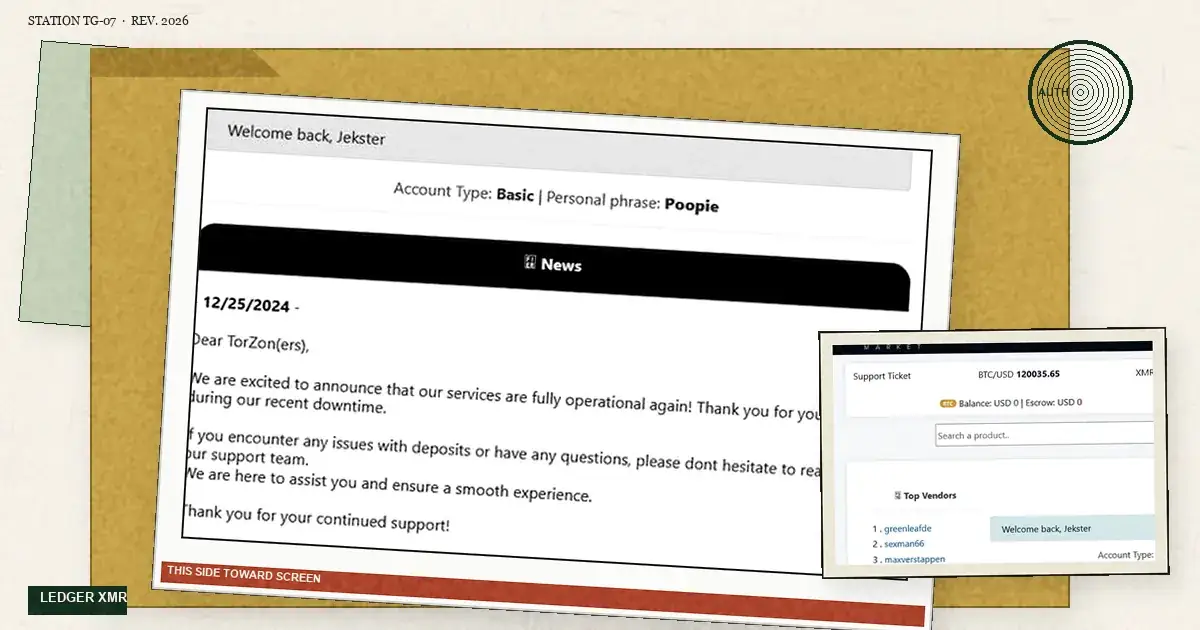
Monero appears on this tor guide because it is prominent in 2026 reporting about Tor-reachable markets, not because the archive offers a payment path. Articles and captured interfaces often use XMR as shorthand for privacy or seriousness, but shorthand can conceal several different claims. This card separates the existence of the label from conclusions about a market's identity, operation, or safety.
No receiving address, exchange route, wallet recommendation, or transfer sequence is provided. Those details would move the page from documentary analysis into financial instruction and would create obvious opportunities for substitution by a lookalike.
The relevant research question is narrower: what does the appearance of Monero language tell us about the source, and what does it leave entirely unproved?
I. How this tor field guide files the Monero word
At most, an XMR label in a dated capture establishes that the photographed interface presented Monero-related text when the image was made. It may help distinguish one interface revision from another or show how an operator framed settlement. It does not demonstrate that a backend accepted transactions, that a displayed address was controlled by the claimed party, or that any privacy promise held in practice.
Affiliate writing frequently turns the label into an endorsement by implication. A service is described as privacy-focused because it names a privacy-oriented rail, then the same adjective is allowed to spill over into claims about account security, escrow, or authenticity. Those conclusions do not follow. An impersonator can reproduce the word and logo as easily as the rest of an interface.
Researchers should quote the claim with its date and source type. On 8 September 2026, a supplied capture or public page may have displayed particular language; the record should say exactly that. If later material differs, preserve the difference rather than rewriting the old observation as though the newest phrasing had always existed.
II. Onion itinerary that still starts with kit
An onion itinerary remains unchanged by settlement branding. First establish the Tor Browser supply chain through the Tor Project's signed release material, then compare the complete v3 string with a prior PGP-signed reference. A valid fifty-six-character name indicates a syntactically plausible v3 service and embeds an Ed25519 identity, but it does not connect that identity to a market name by itself.
Monero-only wording can also be used as pressure, suggesting that a reader must act quickly or prove familiarity before seeing basic information. Such rhetoric is not cryptographic evidence. A gate that reveals identifiers only after downloads, chat interaction, or financial prompts should be documented as a risk signal rather than complied with for the sake of completing a survey.
The parent ledger places XMR beside BTC because the comparison is historical and rhetorical, not competitive. One term dominates newer discussion while the other persists in older captures and clone text. Neither child sheet ranks technologies, recommends acquisition, or offers operational privacy advice.
III. Station notes on sermons, health, and QR codes
Station notes keep payment claims separate from harm reduction. Market articles that mention Monero often sit beside drug descriptions, yet the technical properties of a rail say nothing about substance identity or potency. Drug checking where available, naloxone access, and avoiding solitary use address different risks and should not be displaced by confidence in digital privacy language.
The tor guide XMR card also avoids mixer comparisons, wallet restoration, fee advice, and QR imagery. Apart from being outside the editorial purpose, those elements make destination substitution harder to notice. Plain prose lets a researcher assess claims without placing actionable financial objects on a page likely to be copied.
A copied cream layout that adds a wallet prompt is not an enhanced edition of this record. It has changed from an archive into a solicitation. That remains true even if every paragraph, file code, and rubber-stamp mark around the prompt has been reproduced accurately.
IV. Monero questions that refuse a till
Is this a Monero payment page?
No. It is a dated vocabulary and source-analysis card. The site neither receives funds nor provides addresses, wallet setup, exchange directions, or transaction troubleshooting.
Why do plot rumours mention XMR so often?
The rail is prominent in market and affiliate discourse, and publishers copy established language. Frequency shows a convention in reporting; it does not verify a service or any displayed destination.
Does using a privacy rail make a plot safe?
No. Settlement technology cannot prevent lookalike onion strings, malicious software, false listings, custody failures, or operator misconduct. Each issue needs separate evidence.
Close of sheet
The useful conclusion is limited: XMR language helps describe and date market discourse, while proving very little about the service making the claim. Keep the observation within those bounds.
Return this card to the tor guide ledger without looking for a QR code. The absence is intentional, and any copy that supplies one should be evaluated as a solicitation. Documentary context requires no receiving destination.