Sheet TG-07-Q1 / SIGHT
Sighting Questions on the Tor Guide Desk
Dated overlays. Not telemetry.
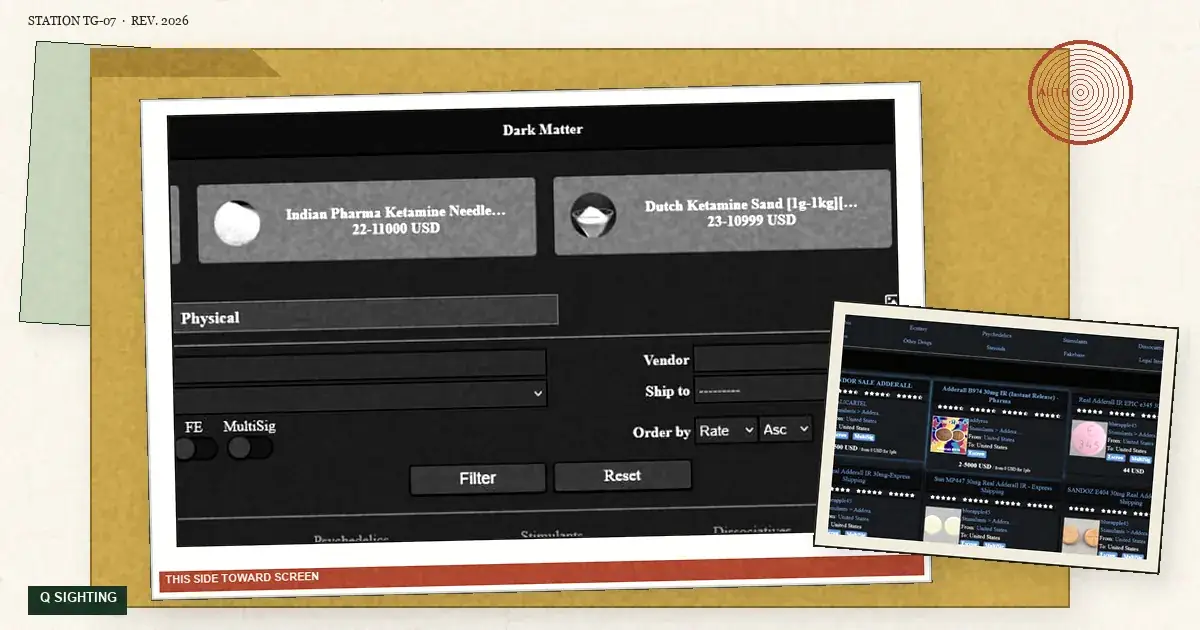
A sighting in this tor guide is a dated observation with a named source type. It may record public HTML, a supplied interface capture, a circulating v3 identifier, or a signed announcement. These objects do not carry equal weight, and the fact that they appear together on a plot sheet must not be read as proof that one authenticates the others.
The room exists because phrases such as seen online or confirmed live routinely conceal who observed what, from where, and when. Static stationery cannot inspect escrow, inventory, disputes, or operator intent.
A careful sighting says less, but another researcher can test its boundaries and revise it when stronger evidence appears.
I. What this tor field guide can honestly sight
Public HTML can establish that a clearnet document displayed particular words at the time it was collected. A photograph can establish that a visual interface was captured, subject to ordinary questions about editing and provenance. A fifty-six-character v3 name can be checked for valid-looking form. None of these facts attributes the material to a market operator without an independent identity bridge.
A PGP-signed statement from a key whose fingerprint was trusted earlier provides such a bridge for the signed text, while the onion name itself binds to an Ed25519 service key. Researchers must still verify what the signed message actually says. A genuine signature over an old or unrelated string does not bless a new string placed nearby by a third party.
The instrument list therefore includes collection date, source URL or source description, capture provenance, exact transcription, signature status, and confidence. It excludes invented telemetry. If the station did not run a documented probe, it cannot report uptime; if it did not inspect internal systems, it cannot report solvency or stock.
II. Onion itinerary that does not chase screenshots
An onion itinerary for sighting review starts by preserving distinctions before following links. Record whether the object is a screenshot, live page, archived copy, quoted message, or signature file. Then ask whether other reports are independent or merely repeat the same wording. Publication count is not witness count when every article copied one affiliate post.
Visual continuity can support a limited design-history observation, but it cannot prove key continuity. Two pages may share typography because one copied the other; one operator may also redesign a genuine service completely. The strongest inference from similar chrome is similarity itself. Claims about ownership require cryptographic or otherwise attributable evidence.
When records conflict, chronology alone does not decide the issue. A newer unsigned page does not overrule an older signed statement simply by being recent. Conversely, an old signature should not freeze an identifier forever if a later statement signed by the established key announces rotation. Preserve both dates and let the evidence hierarchy explain the change.
III. Station notes on lamps, mailrooms, and splashes
Station notes avoid dramatic interpretation of silence. Failure to retrieve an onion service during one attempt can result from local networking, Tor path conditions, service availability, or other causes not visible to the observer. It cannot establish seizure, theft, retirement, or compromise. Those claims require separate documentation and careful attribution.
The tor guide sighting room applies the same restraint to supplied captures. Operator-provided material is useful as an exhibit of what the supplier wanted shown; that provenance should remain visible rather than being transformed into independent reportage. Editorial mounting and a date do not erase the source's interests.
Privacy matters during collection as well. Do not solicit private account screenshots, support tickets, personal identifiers, or transaction records merely to enrich a sighting. Public-interest documentation can remain focused on public claims and interface history without accumulating material that exposes individuals or turns the archive into a leak channel.
IV. Sighting questions that stay observational
What does a sighting verify?
It verifies only the bounded observation described on the card: for example, that a cited page displayed text or that a supplied image showed an interface. It does not verify operations hidden behind that material.
Does a new screenshot update a sighting automatically?
No; it becomes another exhibit whose source, date, and relationship to earlier material must be assessed. Updating a record is an editorial conclusion, not an automatic consequence of receiving an image.
Is inclusion of a plot a sighting that it is safe?
No. Inclusion reflects documentary relevance in 2026 discussion. Safety is a broad judgment this archive cannot derive from public HTML, onion-name format, interface captures, or search visibility.
Close of sheet
A good sighting leaves a trail another researcher can challenge: object, date, provenance, attribution, and limits. It does not hide uncertainty behind a green lamp or confident adjective.
Keep this methods card with the tor guide survey material. When evidence improves, revise the claim explicitly; when it does not, preserve the unknown instead of promoting repetition into fact. The blank space is preferable to a fabricated observation.