Sheet TG-07-N10 / SLIDES
Slide-Mount Card on the Tor Guide Desk
Projection. Not a portal.
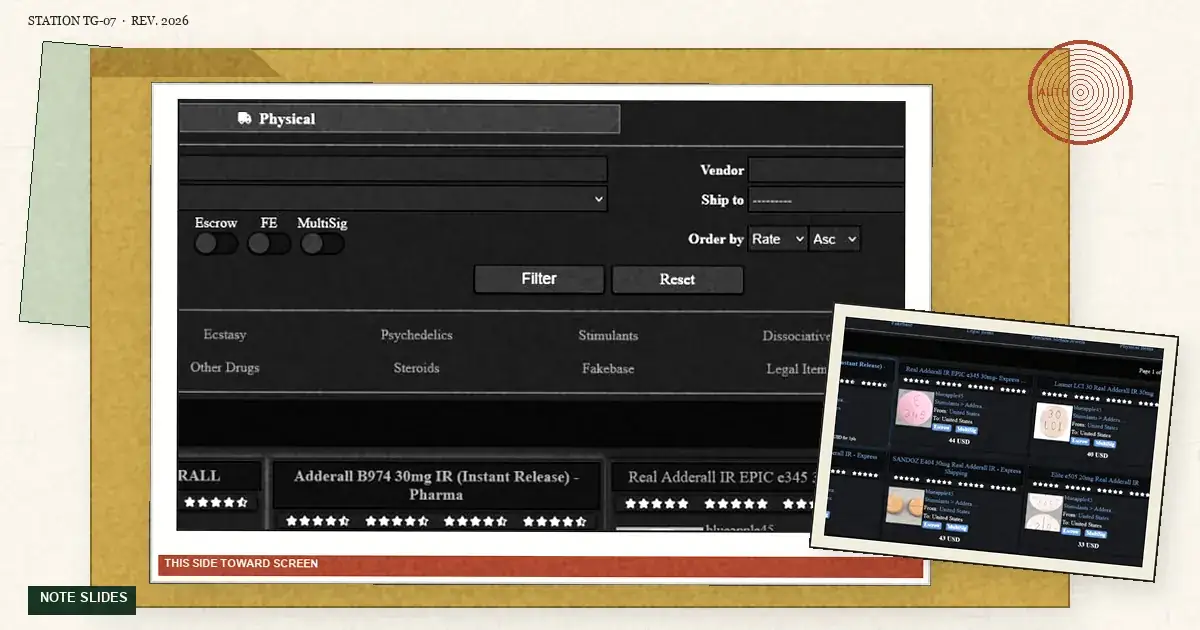
The 35mm mount around a capture is a visual grammar for distance. On this tor guide, cardboard edges tell the reader that the interface has been photographed, selected, and placed in an editorial sequence. It is no longer a browser view, even when every word inside the image remains legible.
A red instruction reads THIS SIDE TOWARD SCREEN because physical slides once required orientation before projection. Here the phrase is literal and cautionary: the image points toward a screen for viewing, not through the screen toward a service. It labels the artifact without supplying an action.
Navy cursive appears only in slide captions. Restricting script to that role keeps a personal archive tone from spreading into buttons, headings, or claims that might be mistaken for signatures. Handwriting can suggest intimacy and provenance; on this site it supplies neither.
I. How this tor field guide frames a capture as a slide
A mount contains an outer card, an inset photograph, a caption area, and the red orientation line. Small rotations mimic handled objects on a desk rather than a product turntable. The still does not rotate interactively, enlarge into a simulated storefront, or hide a destination link.
Different pages use different crops so their OG images describe their subjects rather than repeating one generic hero. Crop selection is ordinary editorial work. A unique crop can be traced to a shared source image and has no relationship to uniqueness of an onion key.
Below-fold slides may load lazily, while an important homepage image may be preloaded for page performance. Those are delivery choices for static WebP files. They do not make the pictured service live, recent, or reachable.
II. Onion itinerary that reads captions as hedges
Captions name what the station knows: photograph, supplied capture, interface detail, crop, or exhibit date. They avoid verbs such as enter and claims such as online. A caption should narrow interpretation, not convert the image into an invitation.
Navy cursive is intentionally softer than the file labels, but visual softness must not weaken the hedge. If provenance is limited, the caption says so in ordinary text. Decorative handwriting cannot substitute for a source note simply because it resembles an archivist's annotation.
Readers who encounter a detached social image should still see enough of the mount and red line to recognize mediation. The frame carries context when a full article cannot, although only the article can explain all evidentiary limits.
III. Station notes on mounts that become portals
A play button would falsely imply video; a pulsing status dot would imply monitoring; a hover zoom that becomes a clickable replica would imply entry. The slide avoids all three. Interaction is not automatically harmful, but these particular cues would contradict the exhibit's role.
In section III, the tor guide reads the red THIS SIDE TOWARD SCREEN line as an instruction to remain a viewer. The phrase is not a secret access cue, and the navy caption is not an operator's hand.
Cardboard, cream stock, and slight wear also distinguish this host from glassy dashboards and neon market replicas. Style alone cannot guarantee purpose, so the decisive features remain the absence of transactional controls and the explicit treatment of images as evidence.
A detached slide should be interpreted even more cautiously. Social platforms may crop away its caption, alter dimensions, or show only the inner photograph. Return to the dated page before assigning meaning to an image that has lost its mount and source note.
The orientation line also discourages fullscreen spectacle. Enlarging a low-context capture can increase emotional presence without recovering the omitted browser state, address provenance, or signature. More pixels reveal detail, not identity.
IV. Note questions on this field card
Why use a 35mm slide mount?
It makes the editorial mediation visible and keeps interface captures in an exhibit register. The mount signals a photograph selected for study, not a live browser window.
Is navy cursive a signature?
No. It is a caption style used only on slides. Cryptographic signatures require verifiable keys and data; handwriting, simulated or real, is visual atmosphere.
What does THIS SIDE TOWARD SCREEN mean?
It borrows a physical slide instruction to emphasize viewing direction. The photograph is projected toward the reader's screen and does not function as a portal through it.
Close of sheet
Read the mount before reading the interface inside it. Cardboard, caption, crop, and orientation line disclose that another editor has already shaped the view.
The tor guide keeps the slide facing the screen. Navy cursive labels the exhibit, red ink fixes its orientation, and neither mark authenticates what the photograph depicts.