Sheet TG-07-N13 / RANGE
Range Card on the Tor Guide Desk
Range is a claim. Not a blessing.
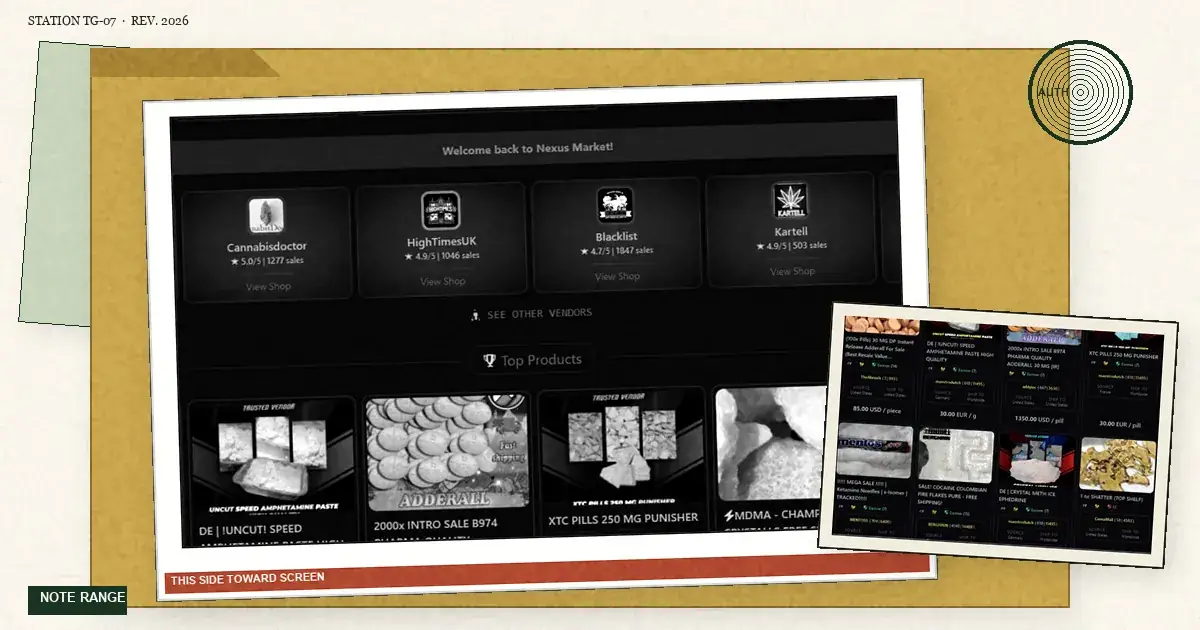
Some operator statements list several onion identifiers for redundancy or rotation. This tor guide cites three strings per plot because three were part of the 2026 source set, not because the number creates safety. Each line is a separate key claim and may be genuine, stale, mistyped, or malicious independently of the others.
Counting can produce false comfort. If one unfamiliar page supplies all three strings, the apparent agreement is still one publisher repeating itself. Even three different directories may have copied a common upstream list. Source lineage matters more than the width of the list.
Range is therefore descriptive: these identifiers were attributed to the same named subject on a given date. It is not a bonus pack, failover promise, or assurance that one of them must work. A reader without prior signed evidence has three unresolved comparisons rather than three chances at certainty.
I. How this tor field guide files extra trunks
Give every identifier its own voucher line with complete characters, date, source, and signature status. Never compress them into a shared prefix plus changing endings; that notation trains the eye to skip the portions an attacker would vary.
If a signed operator document lists several names, verify the document and preserve its chronology. A later signed rotation statement may retire one line while leaving another active. The range record should show that change rather than silently deleting the retired specimen.
A fourth string found in an advertisement remains an advertising claim until independent evidence supports it. It does not join the cited set merely by resembling the others or by presenting itself as a backup unavailable anywhere else.
II. Onion itinerary that refuses bonus-mirror packs
The language of bonus, fastest, and guaranteed mirror turns redundancy into a sales feature. Technical resilience can be discussed without urgency. When a page uses scarcity or rewards to push an extra address, record the persuasion and stop before copying.
Chat widgets and download tools that promise additional mirrors impose an unnecessary intermediary. They can substitute values, collect information, or simply exhaust the reader. A legitimate citation should be examinable as text with a source and date, not unlocked through a conversation.
Comparing only the first of three strings leaves the other two unexamined. Pasting all three in turn is not verification either. If concentration or source continuity is missing, choose one research specimen or none and end the session.
III. Station notes on maps that pretend to be ping tools
This range card does not test reachability. A clearnet ping checker for onion services introduces questions about what is being measured, from where, through which client, and whether results can be manipulated. An unexplained green dot answers none of them.
In section III, the tor guide states the finding without a lamp: three cited strings are not inherently safer than one. Trust depends on each string's relationship to prior signed evidence, while availability is a separate, time-bound measurement this page does not perform.
Geographic node maps can be equally misleading because onion-service architecture does not translate into a simple public pin map. Decorative lines between cities may look technical while disclosing no method. Range here means attributed identifiers, not a diagram of infrastructure.
Conflicting results from third-party checkers would add another unresolved source problem. Without documented clients, timing, exit conditions, and target values, a red or green report cannot be compared responsibly. The card avoids collecting status colors it cannot interpret.
A missing measurement should remain blank rather than become an inferred result.
IV. Note questions on this field card
Why does each plot cite three strings?
The 2026 source set attributed three identifiers to each subject. The page records that claim for analysis; it does not certify the strings or imply that three is a safer number.
Can multiple mirrors confirm one another?
Not by quantity alone. They may originate from one copied list, and each is a distinct key claim. Compare every identifier with appropriate prior signed evidence.
Will this page show which identifier is online?
No. It operates no ping checker or status lamp. Reachability would require a disclosed time-bound measurement and would still be separate from authentication.
Close of sheet
A range map is honest when it shows attribution and uncertainty rather than green dots. More lines increase the comparison workload; they do not distribute trust automatically.
The tor guide files three cited strings as three claims. Without a prior trusted signature, the set remains unresolved, and this static card will not pretend to ping it.